


- 2026 marks a turning point for the work environment, as legacy management models no longer align with AI integration, flexible work, and new employee expectations.
- AI is no longer an experimental trend but a “silent colleague” embedded in almost every daily workflow.
- Workers, especially Gen Z and Millennials, prioritize work-life boundaries, autonomy, and meaning over titles or high salaries.
- Productivity is redefined through microshifting—working according to natural energy rhythms rather than a fixed 8-hour schedule.
- AI is driving the emergence of the “AI-augmented workforce,” where humans focus on creative thinking and decision-making while AI handles repetitive tasks like synthesis and research.
- Recruitment is shifting focus from technical skills to emotional intelligence, communication, and judgment.
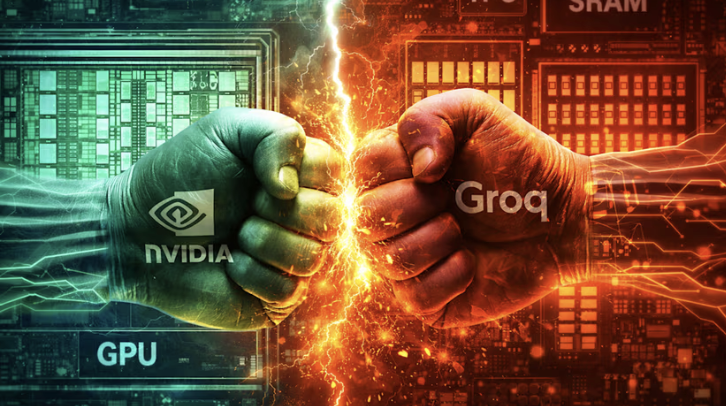
- Nvidia admits for the first time that the “one-size-fits-all” GPU model is ending, signaled by a $20 billion licensing deal with Groq.
- The industry hit the “Inference Flip” in late 2025, when inference revenue surpassed training.
- Inference is splitting into two phases: prefill (context loading, compute-heavy) and decode (token generation, memory bandwidth-heavy).
- Traditional GPUs excel at prefill but struggle with decode, leading to new architectures like Nvidia’s Vera Rubin, which integrates Groq-style silicon for high-speed decoding.
- Anthropic’s “portable” AI stack is weakening the CUDA monopoly by running on both Nvidia GPUs and Google TPUs.
📌 Conclusion: 2026 is a watershed moment where old governance models and general-purpose hardware fail to meet the demands of an AI-driven world. Success now hinges on microshifting, AI-augmented talent focusing on EQ, and a hardware shift from training to specialized inference (prefill vs. decode).
