


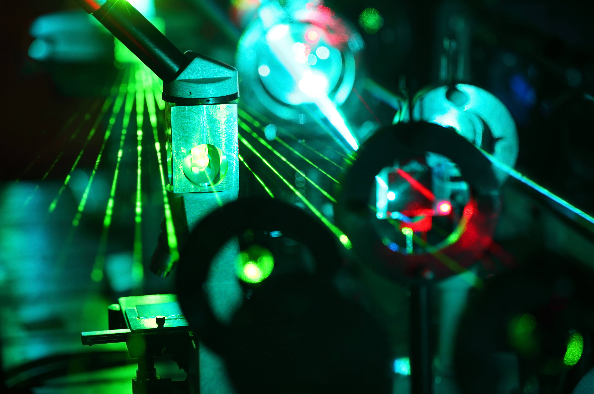
- Scientists at Sandia National Laboratories (under the U.S. Department of Energy) deployed three autonomous AI agents in a lab to optimize LED light steering technology, aiming to replace expensive and power-hungry lasers.
- In just 5 hours, the AI agent system conducted over 300 experiments, achieving LED beam steering results 4 times better than methods previously developed by humans.
- The study, published in Nature Communications, is a clear demonstration of the “self-driving lab” model—a laboratory that operates autonomously with AI directly assisting physical equipment.
- Instead of using LLMs or calling third-party APIs, the research team built three specialized AI models based on mature machine learning algorithms.
- The first model uses a variational autoencoder (VAE, introduced in 2013) to preprocess experimental data.
- The second model applies Bayesian optimization, connecting directly to optical equipment to automatically propose, run, and analyze experiments in a closed loop.
- The third model is a feed-forward neural network acting as a “scientific validator,” inferring formulas and explaining why the optimal configuration is effective.
- This approach avoids hallucinations—a common problem with generative AI—because the models are specifically designed for a narrow task.
- The entire system runs on a single Lambda Labs workstation with three RTX A6000 GPUs, requiring no supercomputing infrastructure.
- Beyond LEDs, this method is expected to be applied to material design, alloys, and printed electronics in the future.
📌 Research by Sandia National Laboratories (under the U.S. Department of Energy) shows that in just 5 hours, a system of 3 AI agents conducted over 300 experiments, achieving LED beam steering results 4 times better than methods previously developed by humans. This has opened up great prospects for self-driving laboratories. This method is expected to be applied to material design, alloys, and printed electronics in the future.
