


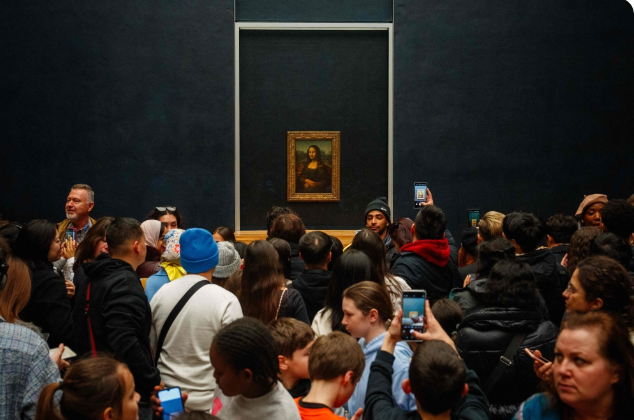
- A Moscow court has rejected a copyright protection claim for images edited by generative AI based on Leonardo da Vinci’s Mona Lisa and the Statue of Liberty.
- The plaintiff claimed to have created two works, “Mona Lisa with Wine” and “Statue of Liberty with Wine,” by processing the original images through neural networks, which were then illegally used on T-shirts, hoodies, sweatshirts, and thermoses for business.
- The plaintiff requested the court to order the defendant to pay compensation for infringing on the copyright of the designs.
- The defendant argued that the changes to the original photos were only minor edits, insufficient to constitute a new creative work protected by law.
- According to the case file, the plaintiff replaced the torch of the Statue of Liberty with a wine glass and added a new background; for the Mona Lisa, they altered the hand position, mouth, facial lines, made the hair fluffier and messier, added eye bags, eye patches, nail polish, and placed a wine glass in her hand.
- The court determined that the disputed images were created using generative AI, which lacks consciousness and cannot perform “creative activity” in a legal sense.
- The court also noted that ideas such as messy hair, a swollen face, holding a wine glass, or replacing a torch with a wine glass are not new and have appeared many times in art and media.
- According to the ruling, entering prompts for AI is merely a mechanical and technical act, which does not create a creative contribution sufficient to give rise to copyright.
- The court concluded that instructing a computer program to apply an existing idea to an available work is simply clarifying a command, not an independent creative activity, and thus is not eligible for copyright protection.
📌 The Moscow court’s ruling shows a strict approach to copyright for generative AI content. Despite the user modifying many details on the Mona Lisa and the Statue of Liberty, the court held that the use of prompts and AI is a technical process, not human creation. This case may become a notable reference in future copyright disputes involving works created or edited by AI.
