


- China is promoting a “China-buys-China” strategy amid tech tensions with the US, aiming to develop its own chips and AI instead of relying on Nvidia.
- Nvidia still dominates the AI training chip segment, but the inference market—generating responses from a trained model—is opening up new opportunities. Inference chips are less complex, cheaper, and a suitable area for Chinese companies to close the gap with Nvidia.
- After the US tightened export controls, Nvidia halted production of its H20 chip for China; Beijing also advised companies to stop purchasing it due to security concerns. DeepSeek recently upgraded its V3 model to be optimized for domestic chips.
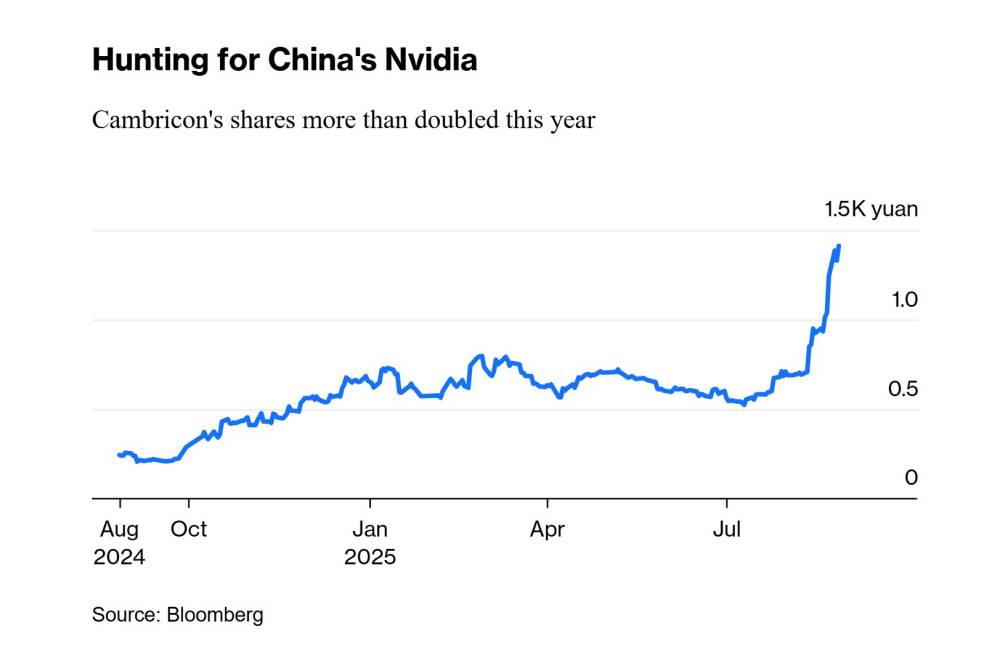
- Cambricon Technologies, founded in 2016 and listed on the STAR board in 2020, has become a market favorite on expectations of capturing inference market share. Its stock has doubled in 2025.
- Despite strong revenue growth, the company has negative cash flow and plans to raise nearly 4 billion CNY (US$560 million) to invest in AI chips and software.
- Cambricon’s method of raising capital from the stock market is seen as more effective than the complex state-backed model that led to Tsinghua Unigroup’s bankruptcy in 2021 and a subsequent corruption scandal at the “Big Fund.”
- The government is changing its tech funding strategy: encouraging venture capital for small, core-innovation enterprises; and restricting poor localities from pouring capital into AI. In July 2025, President Xi Jinping publicly warned about over-investment.
- Cambricon’s founder, Chen Tianshi (40), holds a 29% stake; the Chinese Academy of Sciences holds 16%, showing the link between basic science and commercialization.
- Investors are being encouraged to act as a “natural filter” to find the real Chinese versions of Nvidia, replacing risky and direct state intervention.
📌 Amid tech tensions with the US, China is promoting a “China-buys-China” strategy, aiming to develop less complex, cheaper inference chips suitable for Chinese companies to close the gap with Nvidia. The government is changing its tech funding strategy: encouraging venture capital for small, core-innovation enterprises and restricting poor localities from pouring capital into AI. In July 2025, President Xi Jinping publicly warned about over-investment. Cambricon has emerged as a symbol, with its stock doubling in 2025 and raising US$560 million for R&D, despite still burning cash. Cambricon’s founder, Chen Tianshi (40), holds a 29% stake, while the Chinese Academy of Sciences holds 16%, showcasing the link between basic science and commercialization.
