


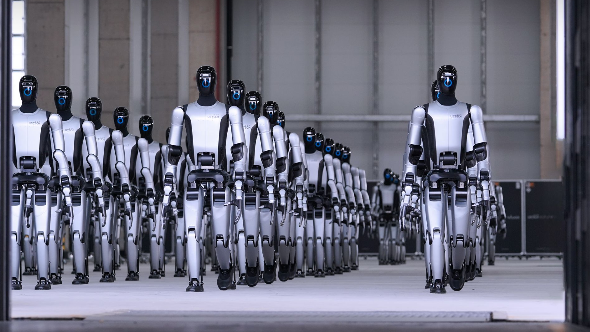
- China signed a contract valued at 264 million yuan ($37 million USD) to deploy industrial humanoid robots at border crossings in Guangxi, with deliveries starting in December.
- UBTech partnered with the humanoid robot center in Fangchenggang – a city bordering Vietnam – using the Walker S2 model launched in July. This is the world’s first robot capable of fully automatic self-battery-swapping.
- The pilot program uses Walker S2 at the border gates to guide visitors, manage human traffic flow, assist with patrols, handle logistics, and support commerce; while also conducting inspections at steel, copper, and aluminum factories.
- The move indicates the accelerating commercialization of embodied generative AI in China, with strong policy backing from many provinces and cities.
- Robots have been deployed at Hangzhou Airport, government offices, and major events; multilingual robots appeared at the SCO Conference in Tianjin; patrol robots have been deployed in Shenzhen, Shanghai, and Chengdu.
- Walker S2 stands about 1.76 m tall, has 52 degrees of freedom, and 4th-generation hands with 11 degrees of freedom per side, allowing manipulation accuracy of less than 1 mm.
- The robot can carry a maximum load of 15 kg in each hand, operates from ground level up to a height of 1.8 m; high-torque joints support deep squatting and flexible manipulation.
- The dual hot-swap battery system allows for self-battery-swapping in about 3 minutes, maintaining near 24/7 operation.
- It integrates BrainNet 2.0 and the Co-Agent AI framework, supporting multimodal reasoning, task planning, and exception handling.
- Environmental awareness is provided by stereo RGB cameras, and stable movement is achieved with a maximum speed of 7.2 km/h.
- UBTech reported total orders for the Walker series reached 1.1 billion yuan ($115 million USD), aiming to deliver 500 robots this year, increase tenfold next year, and reach 10,000 robots/year by 2027.
- The National Humanoid Robot Committee was established by MIIT, appointing leaders from UBTech, Unitree, AgiBot, and the Shanghai Humanoid Robot Innovation Center.
- Chinese robots are expanding into healthcare, elderly care, urban sanitation, traffic management, security, and autonomous delivery via metro and drones.
📌 China’s UBTech company partnered with the humanoid robot center in Fangchenggang – a city bordering Vietnam – using the Walker S2 model launched in July. This is the world’s first robot capable of fully automatic self-battery-swapping in 3 minutes, carrying a load of 15 kg in each hand, with a speed of 7.2 km/h and hands capable of manipulation accuracy of less than 1 mm. Walker S2 is being piloted at border crossings to guide visitors, manage human traffic flow, assist with patrols, handle logistics, and support commerce; while also conducting inspections at steel, copper, and aluminum factories.
