



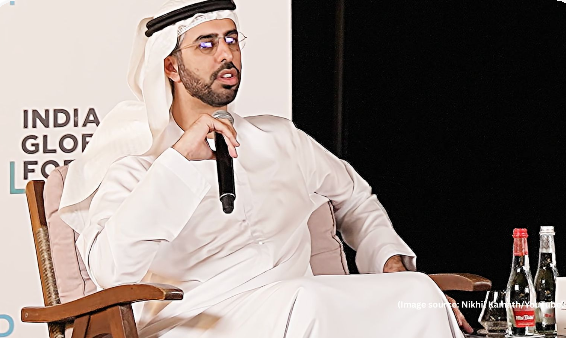
- Omar Sultan Al Olama, the UAE Minister of AI and the world’s first AI minister, shared his views on AI, jobs, and generational strength at the India Global Forum in Dubai.
- He argued that the 40–60 age group is the “best generation” in the context of the AI boom.
- The core reason: they lived long enough in the pre-Internet era and matured alongside digital technology, creating a rare cognitive balance.
- According to Al Olama, modern society has lost the “breadth of intelligence” that once helped humans manage daily life without depending on technology.
- He observed that technology arriving later in the lives of the 40–60 generation makes them “better” at synthetic thinking capabilities.
- Conversely, younger generations often lack the practical knowledge that the previous generation possesses.
- Al Olama noted that in the pre-Internet era, humans – even those without formal education – could build multi-billion dollar companies thanks to a deep understanding of nature and technology directly related to their fields.
- He warned of the risks of today’s “hyper-specialized” world.
- According to him, if humans are forced to be hyper-specialized, AI will outperform humans in achieving goals.
- AI is particularly strong in narrow environments with clear structures and specific objectives.
- Therefore, betting an entire career on extremely narrow expertise makes humans easily replaceable by AI.
- Advice for the youth: shift from “intelligence-specific” to “broad intelligence.”
- He quoted Shakespeare: “A jack of all trades is a master of none,” but emphasized the often-omitted second part: “But oftentimes better than a master of one.”
- Key message: in the AI era, synthetic thinking, multidimensional experience, and interdisciplinary understanding become more valuable than ever.
📌 UAE AI Minister Omar Sultan Al Olama argues that the 40–60 age group holds a unique advantage in the AI era thanks to experiencing both the pre-Internet world and the digital age. He warns that hyper-specialisation makes humans easily surpassed by AI, whereas “broad intelligence” – based on experience, interdisciplinary understanding, and practicality – is a sustainable capability. With AI becoming increasingly powerful, synthetic thinking may be more important than narrow expertise.


