


- China has announced its technology strategy in the 15th Five-Year Plan with the goal of achieving global leadership in technology and AI by 2030, while competing directly with the US in the tech race.
- A key objective is to integrate AI into 90% of the economy within five years, covering manufacturing, e-commerce, transportation, energy management, and business operations.
- Beijing will invest billions of dollars to develop 10 strategic sectors such as humanoid robots, AI systems for the workplace, 6G technology, fusion energy, quantum technology, bio-manufacturing, and brain-computer interfaces.
- The plan also promotes the “low-altitude economy” including flying cars and drone delivery services to expand automated transport and logistics applications.
- A major pillar of the strategy is keeping many AI models open-source to encourage free use by businesses and developers, then creating a paid service ecosystem around AI implementation and integration.
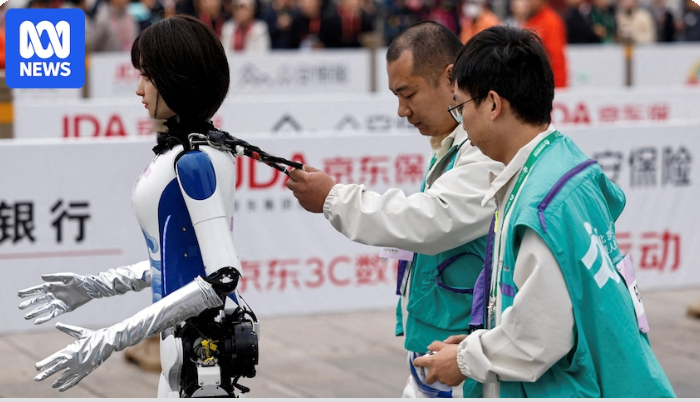
- China is also betting big on humanoid robots. In 2025, about 16,000 humanoid robots were sold globally, and approximately 90% came from Chinese companies, with over 150 enterprises in this field.
- Beyond humanoid robots, China deployed over 2 million industrial robots in factories in 2024, about five times more than the US, along with “dark factories” where robots operate with almost no human intervention.
- However, the biggest obstacle to the plan is the dependence on advanced AI chips from the US. Export control measures since 2022 have restricted China’s access to high-performance chips needed for training AI models.
- While China is developing domestic chips, experts say its best AI chips are currently about five times weaker than top US chips, making the goal of technological self-reliance challenging.
📌 China’s new technology plan aims to make AI the foundation of 90% of the economy by 2030, with massive investments in robotics, future technologies, and an open-source AI ecosystem. While the country already leads in industrial and humanoid robotics, it remains dependent on advanced AI chips from the US. The success of this strategy will depend on achieving semiconductor self-sufficiency and implementing AI across the entire economy, factors that could shape the global technological landscape over the next decade.
