



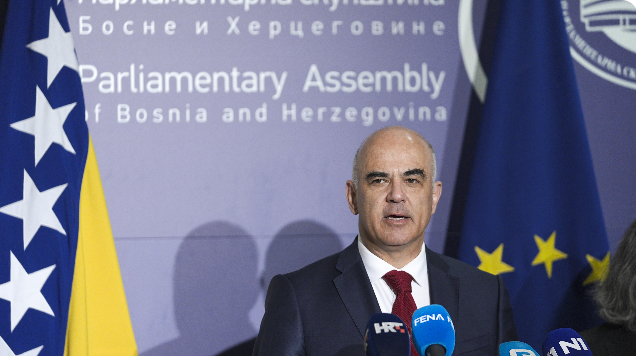
- Secretary General of the Council of Europe Alain Berset warns that AI is developing faster than the ability to build a global governance framework.
- A survey of European youth shows that 46% believe the internet in 2036 will be different to an extent currently unimaginable.
- Conflicts in Ukraine and Gaza are weakening the international order just as AI needs common rules more than ever.
- AI makes information manipulation campaigns more effective, threatening elections and trust in democracy.
- Before the Moldova elections, over 100 fake accounts sponsored by Russia generated approximately 50 million views in less than three months.
- AI can influence decisions on credit, recruitment, healthcare, border control, and law enforcement if oversight mechanisms are lacking.
- The author argues that corporate self-regulation is not enough; laws are needed to ensure the right to know, to be explained to, and to appeal AI decisions.
- The Council of Europe Framework Convention on AI is the first binding international treaty on AI, focusing on human rights, democracy, and the rule of law.
- The convention currently has 21 signatories, including the entire G7, and was first ratified by the European Union in May 2026.
- The article calls on nations to build a common set of rules instead of creating separate AI standards, to avoid fragmentation and ensure AI serves humanity.
📌 AI governance needs to be based on international law rather than just technology or voluntary commitments. In the context of a volatile global order, AI opens great opportunities for medicine, science, and innovation while also creating risks of information manipulation and human rights violations. With 21 countries having signed the Framework Convention on AI and the European Union’s ratification, the author calls for expanding global cooperation to establish common rules for AI.


