

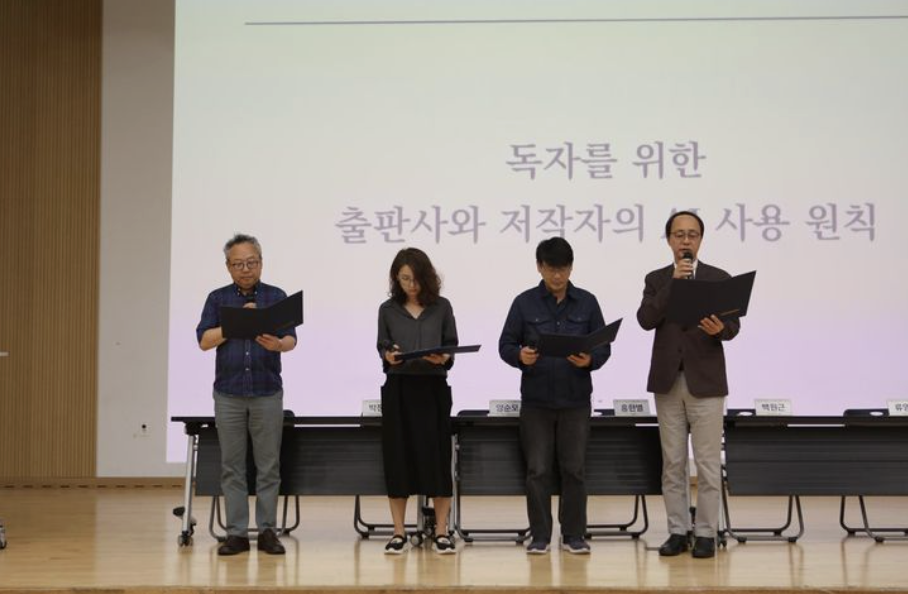
One of South Korea’s two major publishing organizations has released a set of AI usage principles to counter mass-produced AI books, commonly known as “click-to-publish.”
The Korea Publisher Society stated that the goal is to maintain trust in books by clearly defining human responsibility and roles throughout the publishing process.
The set of principles titled “Principles for the Use of AI by Publishers and Authors for Readers” consists of 5 chapters and 20 articles, drafted with the participation of 11 organizations, including the Writers Association of Korea and the Critics Alliance.
This marks the first time the South Korean publishing industry has established AI-related guidelines.
The principles address systems for identifying AI use in production and distribution, data used to train AI, and recommendations regarding contracts.
Although lacking legally binding power, the principles are seen as preparation for future legal and institutional measures.
The Korea Publisher Society affirms that AI is merely a tool and lacks authorship status; the use of AI in the publishing process must be disclosed to readers.
When works are used as AI training data, rights holders must give consent and receive fair compensation.
The book industry also requires clear procedures for restricting book distribution due to failure to disclose AI usage, while protecting copyright and translators’ responsibilities.
📌 Conclusion: The South Korean publishing industry has introduced its first AI framework comprising 5 chapters and 20 articles, formulated with 11 participating organizations. The core focus is transparency in AI usage, denying AI authorship status, requiring consent and fair compensation for training data, and protecting the rights of authors, translators, and publishers.
