


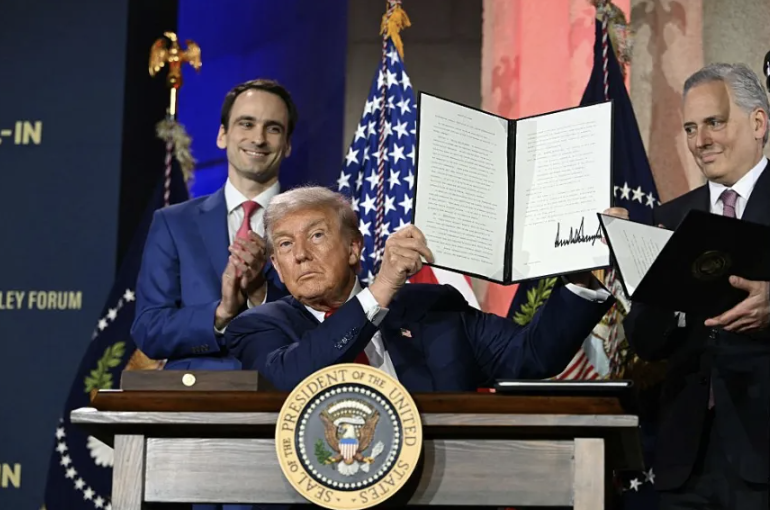
- For the first time, Washington is close to setting AI regulatory standards, but the fierce debate revolves around “who has the right to regulate” rather than the technology itself.
- In the absence of federal standards, states have proposed dozens of bills: California with SB-53 on AI safety; Texas with the Responsible AI Governance Act prohibiting intentional AI misuse.
- Big Tech and Silicon Valley startups object, arguing that a “patchwork” system among states will stifle innovation and cause the US to lag behind China.
- Efforts in Congress seek to insert a clause into the NDAA to prevent states from enacting their own AI laws; the White House also leaked a draft Executive Order (EO) creating an “AI Litigation Task Force” to challenge state laws.
- The draft EO allows David Sacks – AI & Crypto Czar – to co-lead the development of a unified legal framework, prioritizing federal over state precedent; he openly supports limiting state powers and encouraging self-regulation.
- Pro-AI PACs like Leading the Future have raised over $100 million, launching a $10 million campaign to push Congress to adopt a federal standard to replace state laws.
- Many state leaders fight back: over 200 legislators signed a letter opposing the stripping of state powers in the NDAA; nearly 40 state attorneys general also sent a letter demanding the retention of AI regulatory authority.
- New York State lawmaker Alex Bores – the first target of the PAC’s attack – said reasonable regulation is needed for reliable AI and sustainable competition.
- States are moving faster than the federal government: by November 2025, 38 states had passed over 100 AI-related laws, mainly concerning deepfakes, transparency, and AI use in government.
- Congress is slow: hundreds of bills have been introduced but few have passed. Since 2015, Representative Ted Lieu submitted 67 bills, only 1 became law.
- Experts like Bruce Schneier argue that fears of a “patchwork” are exaggerated: Big Tech still complies with strict EU regulations, and many industries operate well under differing state laws.
- To create a federal AI standard, Representative Lieu is preparing a megabill over 200 pages long, focusing on fraud, deepfakes, child protection, transparency, whistleblowers, and requiring model testing and results disclosure.
- The megabill does not require federal agencies to evaluate models before release, making it softer than proposals from Hawley and Blumenthal, but Lieu says its “moderation” increases its chances of passing in the Republican-controlled Congress.
📌 Summary: The US is facing a fierce conflict between the federal government and states as 38 states have passed over 100 AI laws, while Big Tech and the White House seek to block states’ authority to enact AI laws. Over $100 million has been raised to lobby Congress to pass federal AI laws, and Congress is preparing Representative Lieu’s over 200-page AI bill to create a national standard. The debate revolves around speed, authority, and the level of consumer safety in the AI era.


