



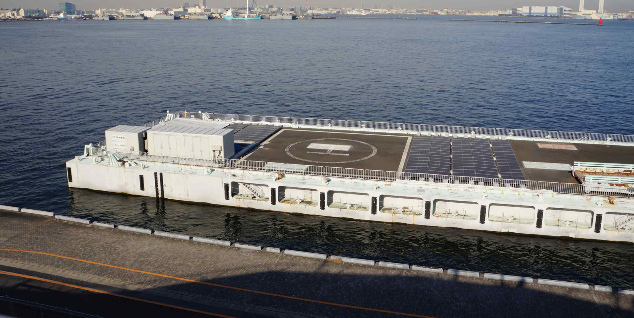
- At Osanbashi Pier, Yokohama, a box-shaped data center measuring 25 meters wide and 80 meters long is floating on the water, integrating a data center, solar power, and storage batteries.
- The project is a pilot for an offshore floating data center using 100% renewable energy, a collaboration between NYK Line, Eurus Energy Holdings, and the Yokohama government.
- Operations are expected to begin by the end of March 2026, testing stability when using renewable power, the impact of saltwater corrosion, and other technical criteria.
- After the testing phase, NTT Facilities will design a large-scale version, with financial backing from MUFG Bank, aiming for commercialization around 2030, sourcing power from offshore wind.
- Advantages include placing the data center close to the power source, utilizing surplus wind energy, not burdening the power grid, and reducing costs through seawater cooling.
- In parallel, JERA plans to build a data center in a coastal industrial zone, right on the premises of a power plant at Yokohama Port; a memorandum of understanding was signed with the city in October 2025.
- Locating it at a power plant almost eliminates the need for new transmission lines, reduces impact on residential areas, and shortens construction time.
- Demand is booming due to generative AI; Japan’s data center market is expected to reach 5.08 trillion yen (approx. $32.9 billion USD) by 2028, an increase of over 80% in 5 years according to the Ministry of Internal Affairs and Communications.
- Urban areas remain attractive due to low latency for autonomous vehicles and financial services; some projects in Tokyo, like Nihonbashi, have been operational since autumn 2025.
- Yokohama Port aims for carbon neutrality, reducing docking fees for ships using methanol or biofuels starting January 2026.
📌 Yokohama (Japan) is testing a floating data center model running on 100% renewable energy, expected to operate by late March 2026, aiming for commercialization by 2030, alongside a project located at a power plant. Advantages include proximity to power sources, utilization of surplus wind energy, zero grid pressure, and cost reduction via seawater cooling. Japan’s data center market is projected to reach $32.9 billion by 2028, growing over 80% in 5 years.


