


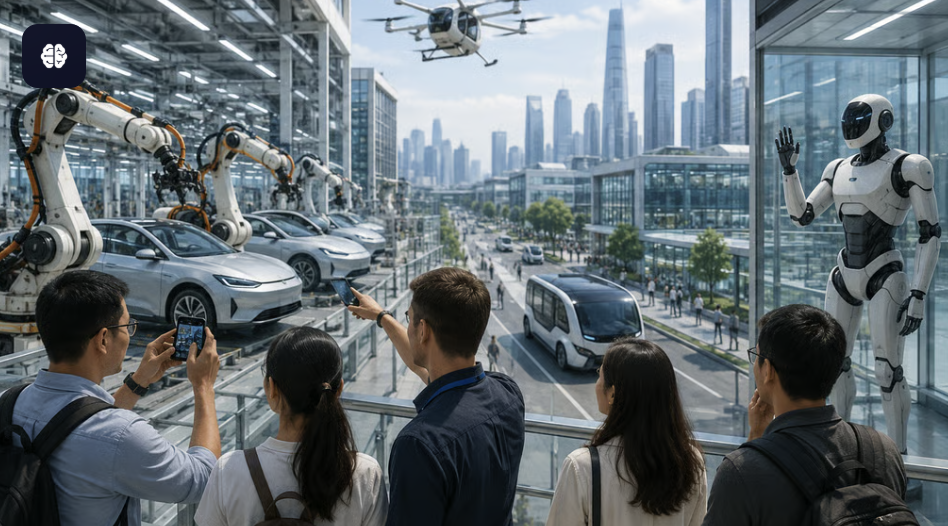
China is witnessing the rapid development of tech tourism focused on AI and robotics.
An increasing number of international investors, entrepreneurs, students, and tourists are visiting Chinese tech hubs.
Prominent destinations include Shanghai, Shenzhen, Wuhan, and Hangzhou.
Many tour programs last from 3 to 5 days, with costs reaching up to $9,000.
Visitors gain access to electric vehicle (EV) factories, robotics laboratories, and AI startups.
The tours usually include private discussion sessions with tech business leaders.
Companies featured in the itineraries include BYD, Unitree Robotics, and DeepSeek.
Many of these manufacturing and research areas are otherwise not open to regular tourists.
Participating investors assess that the greatest value is the ability to directly access the tech ecosystem.
An expert from New York University noted that FOMO (fear of missing out) is driving the demand for real-world experiences.
Many people worry they will fall behind if they do not witness China’s technological development with their own eyes.
The company GloPen in Shanghai has served over 1,000 clients in less than 2 years.
Clients come mainly from Southeast Asia, India, and Europe, while demand from the US and Brazil is rising.
New programs also target students and families who want early exposure to AI and robotics.
The Chinese government views smart tourism as part of its national strategy.
AI, virtual reality, and big data are being integrated into interactive tourism experiences.
Beijing is developing tour routes that combine aerospace, robotics, and industrial parks.
In 2025, China recorded over 6.5 billion domestic tourist trips and over 150 million international visitor arrivals.
Industrial tourism currently accounts for less than 5% of China’s tourism industry, lower than the global average of 10% to 15%.
This market is forecast to grow at an average rate of 18% per year and exceed 300 billion yuan, equivalent to approximately $41.8 billion, by the 2029–2030 period.
📌 Conclusion: China is transforming AI, robotics, and high-tech manufacturing into a promising new tourism sector. Instead of just sightseeing traditional landmarks, tourists can now directly experience BYD’s EV factories, Unitree’s robots, or AI startups like DeepSeek. With an expected growth rate of 18% per year and a market size projected to surpass 300 billion yuan (about $41.8 billion) before 2030, tech tourism is becoming a tool that both boosts the economy and reinforces China’s image as a leading global tech superpower.
