



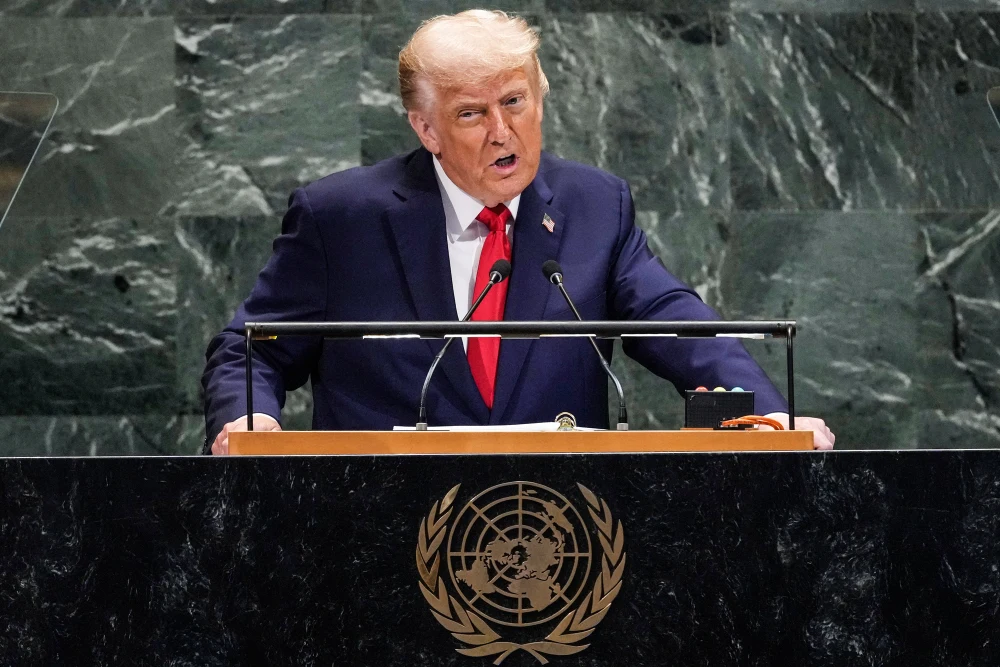
- At last week’s UN General Assembly session, the US clashed with many world leaders by rejecting calls for global AI oversight. Michael Kratsios, US Chief Technology Officer, declared: “We absolutely reject any attempts by international organizations to impose centralized control and global governance over AI.”
- Kratsios emphasized that the future of AI lies not in “bureaucratic management” but in the independence and sovereignty of nations.
- President Donald Trump, in his General Assembly speech, said the US would lead in building an AI verification system for the Biological Weapons Convention. He viewed AI as both a “great tool” and a “potential danger.”
- The US Department of State affirmed support for cooperation with “like-minded nations,” but opposed international efforts that could hinder innovation and increase the influence of authoritarian regimes.
- Conversely, the UN launched the Global Dialogue on AI Governance – the first global dialogue mechanism on AI, aiming to “lay the foundation for a global AI ecosystem” (according to Secretary-General António Guterres). Nobel laureate Daron Acemoglu warned that AI is “the greatest threat humanity has ever faced.”
- UN Envoy Amandeep Singh Gill countered, arguing that the US perspective “misunderstood” the UN’s role. He said it was not about “top-down governance,” but a platform for cooperation among nations.
- China supported the UN’s central role in AI governance, calling for a “fair, open, anti-unilateral and protective environment.”
- Spanish Prime Minister Pedro Sánchez also emphasized the need for a coordinated common vision on AI at a global level, with the UN as the legitimate forum for reaching consensus.
- Expert Renan Araujo (Institute for AI Policy and Strategy) noted that the US has succeeded with bilateral alliances, but AI will increasingly create cross-border challenges, requiring broader cooperation.
- Last year, the UN adopted the Global Digital Compact, laying the foundation for AI dialogue and establishing an international scientific council to assess AI. The first plenary meeting of the Global Dialogue will take place in Geneva in the summer of 2026, coinciding with the AI for Good conference.
📌 At last week’s UN General Assembly session, the US clashed with many world leaders by rejecting calls for global AI oversight, emphasizing national sovereignty and innovation. President Donald Trump, in his General Assembly speech, said the US would lead in building an AI verification system for the Biological Weapons Convention. He viewed AI as both a “great tool” and a “potential danger.” Meanwhile, China, Spain, and many other countries supported the UN playing a central role. This opposition signals an increasingly intense global AI policy struggle, as AI promises great contributions but also harbors cross-border risks.


