


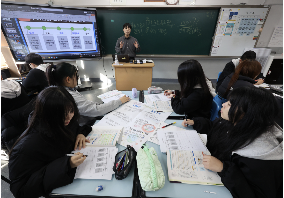
- A study published in January 2026 shows that 94.7% of middle and high school students in Seoul have used generative AI.
- The survey was conducted by the Seoul Education Research and Information Institute in July 2025, with 26,541 students participating.
- Of these, 93.8% of middle school students and 96.7% of high school students had used generative AI at least once.
- Commonly used tools include ChatGPT and Gemini.
- 80% of students stated they use AI for educational purposes.
- 42.5% use AI during classroom activities, while 35.7% use it for self-study.
- AI is used most in language subjects like Korean and English, with over 60% of students using it.
- The usage rate in mathematics is 38.3%, while music and art are below 20%.
- In Korean language subjects, students use AI to write essays, create presentations, generate infographics, and summarize texts.
- In English, AI is used to translate sentences, learn vocabulary, and check pronunciation.
- The widespread use of AI has raised significant concerns among teachers.
- 93.4% of the 3,334 surveyed teachers believe students are becoming overly dependent on generative AI.
- 92.4% are concerned about plagiarism risks, and 92.5% fear students are becoming passive with diminished critical thinking.
- However, only 47.6% of teachers said they have taught students how to use generative AI in class.
- The main reasons for not teaching AI are lack of time (37.7%), lack of understanding of AI (22.8%), and deeming it unnecessary (12.2%).
- More than 60% of teachers themselves use AI in their teaching work.
- 58.3% use AI to write student assessment comments, and 18.9% use it to prepare lesson plans.
- About 70% of teachers have incorporated AI into classroom activities, and over 60% use AI to grade or evaluate assignments.
📌 Nearly 95% of students in Seoul, South Korea, have been exposed to generative AI, mainly for learning purposes, especially in language subjects. Meanwhile, over 90% of teachers are concerned about student dependency, plagiarism, and declining critical thinking. The paradox lies in the fact that less than half of teachers provide guidance on AI usage, even though the majority of them have applied AI to assessment, grading, and classroom management, revealing a significant gap in formal AI education.


