


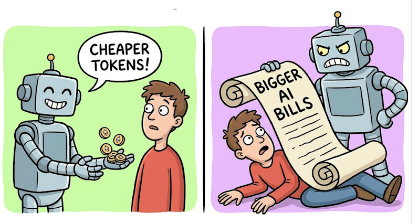
- On October 16, 2026, Gartner forecast that inference costs per AI Agent workflow would increase more than fivefold by 2028, even as token generation costs continue to decline.
- Gartner calls this phenomenon the “Inference Paradox”: computational efficiency improves, but businesses use more powerful models that consume more tokens.
- According to Gartner, AI Agents consume 5–30 times as many tokens as basic chatbots when performing the same task. Providers’ inference costs also increase by at least fivefold when switching to reasoning-capable Agent models.
- The main reason is that AI companies continue investing in advanced models that require greater computing power, while businesses expand their use of AI into more complex workflows.
- Gartner predicts that costs will fluctuate in waves with the launch of new technologies rather than rise steadily.
- A VentureBeat survey of 109 participants found that 21% of businesses using Agent orchestration platforms had no automatic mechanisms to cap token costs.
- Meanwhile, 31% shifted frequent, high-volume tasks to cheaper models to control budgets.
- Gartner recommends strengthening cost monitoring through AI FinOps and measuring expenses for each work outcome.
- Businesses need to automatically route tasks to suitable models and avoid using expensive models for simple tasks.
- Other measures include setting efficiency thresholds, testing cost risks, and leveraging proprietary data to develop specialized models.
📌 Gartner warns that AI Agent costs will not fall in line with token prices. By 2028, inference costs per workflow could rise more than fivefold as Agents consume more tokens and use more complex models. Gartner recommends shifting from managing token prices to managing costs per outcome, combining consumption monitoring, model routing, and economic efficiency assessments before scaling deployments.
