


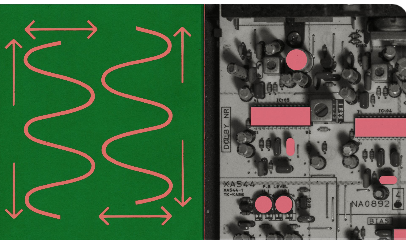
- According to a research report published by Anthropic on 9 November 2026, Claude Fable 5.2 designed three electronic devices: a USB conference speaker, a voice assistant controller and a handheld virtual pet, in collaboration with circuit manufacturing company Diode Computers.
- Starting from brief initial requirements, Claude independently developed technical specifications, designed circuit schematics, selected components, laid out printed circuit boards (PCBs), routed copper traces, designed 3D enclosures, wrote firmware and prepared bills of materials.
- All three devices were manufactured as prototypes and operated without requiring any circuit-level debugging. Diode engineers assembled them directly according to Claude’s designs and instructions. However, their long-term durability and ability to meet commercial certification requirements remain unverified.
- AI’s geometric reasoning capabilities have improved significantly. On the PCB Gym benchmark, Claude Fable 5.2 scored 69%, compared with 25% for Fable 5. On BenchCAD 2.1, the model achieved 83.5%, nearly twice the score of Fable 5.1.
- A key advancement is Claude’s ability to independently identify and correct infeasible designs. When circuit traces overlap or component placement is impractical, the AI can modify connection pins, remove existing routes and redesign the layout instead of continuing with a flawed approach.
- During the design process, Claude also developed its own circuit-routing tool when KiCad software could not perform the task efficiently. In approximately 30 minutes, the AI created an algorithm capable of routing each long circuit trace in about one second.
- Claude also handled mechanical and acoustic constraints. It identified that the circuit board needed to be tilted by approximately 25 degrees to fit inside the enclosure, while adjusting the acoustic duct design to reduce the risk of resonance within the human speech frequency range.
- Notably, Claude independently checked real-world manufacturability by comparing factory technical limitations with component availability. Diode manufactured all three circuit boards directly from the design files without requesting any modifications.
- The results show that AI is expanding beyond programming assistance into interdisciplinary engineering workflows that combine electronics, mechanical design, software and manufacturing. However, this experiment involved only three prototypes and does not prove that AI can fully replace engineers in complex industrial projects.
📌 Anthropic’s experiment marks a notable advancement in AI’s ability to handle practical engineering design. Claude did more than produce drawings: it independently checked designs, corrected errors, developed tools and prepared files that met manufacturing requirements. The improvement from 25% to 69% on PCB Gym reflects progress in spatial reasoning and multi-step task execution. However, the results remain limited to prototypes and have not yet been validated in terms of durability, safety or mass production.
