



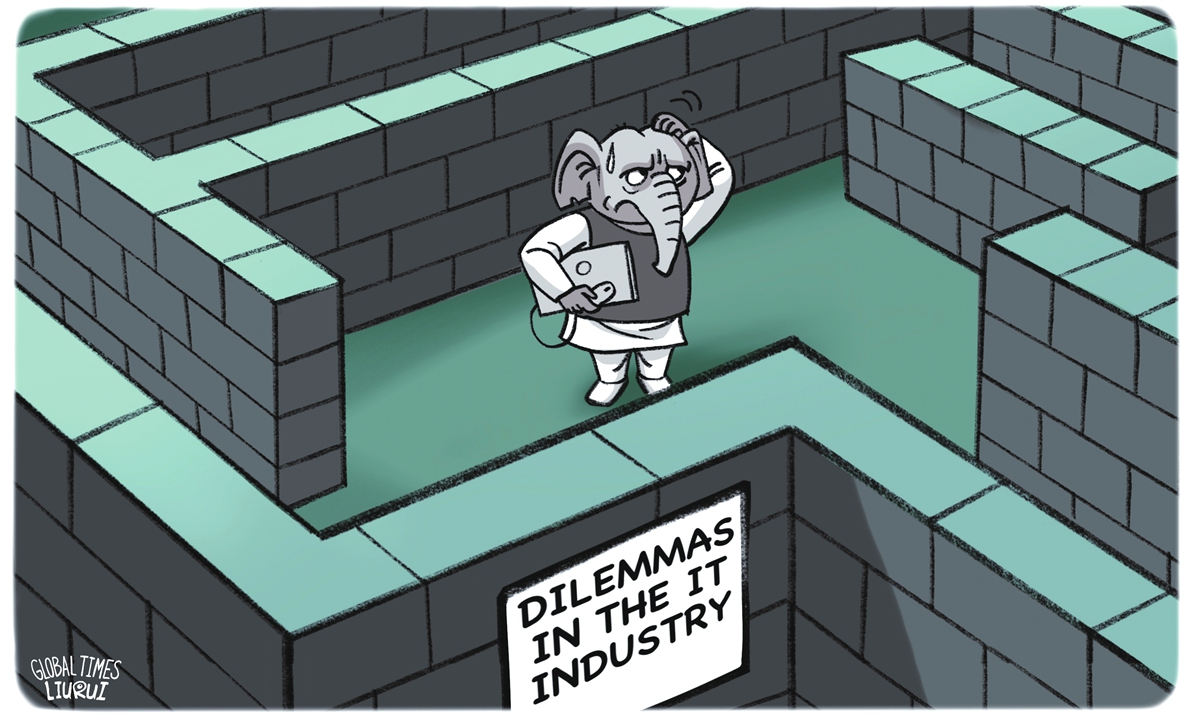
- In 2025, the Indian IT sector faces two major shocks: in January, China’s AI DeepSeek R1 surpassed ChatGPT in downloads, causing a tremor in New Delhi; in July, Tata Consultancy Services (TCS)—the country’s largest IT company—announced layoffs of 12,000 employees (2% of the workforce) in the fiscal year 2026.
- The IT industry, valued at $283 billion, accounting for over 15% of the global market share and a pillar of India’s service exports, now exposes its weaknesses: lack of innovation, reliance on cheap labor and high-volume outsourcing instead of high-value products.
- Since the 1990s, the industry leveraged its English language advantage, attracting investment through tax incentives, transforming India into the “back office” of the world. But R&D investment accounts for only 0.6–0.7% of GDP, far lower than China (2.68%) and the US (3.5%+).
- Global product achievements are limited: no competitive operating system, browser, or social network. Some bright spots exist, such as Zoho (online office suite) or Finacle (banking software), but they are rare. The startup ecosystem is weak, monopolistic structures stifle innovation, and talent is bleeding abroad.
- AI poses a direct threat: ChatGPT, Claude, DeepSeek R1 automate debugging and querying—tasks that were the core of IT outsourcing. DeepSeek also creates cost pressure, prompting an Indian leader to lament: “Why not from Bengaluru?”
- The government responded with a national AI program, mobilizing 18,693 GPUs to build a multilingual model. But the TCS layoffs reveal the risk of massive job losses due to “skill mismatch.”
- The second shock: The US, which accounts for 50% of India’s IT revenue, imposed a 25% tariff starting in July and 50% from late August 2025 on most Indian goods. Although not directly targeting services, AI could enable US businesses to “reshoring”—automating in-house instead of outsourcing.
- Consequences: threat to 5.4 million direct jobs, increasing unemployment and social instability during the election period; pressure to devalue the rupee, inflation, and weakening foreign exchange reserves while industrial production remains backward.
- Solution: sharply increase R&D spending, reform labor laws to be more flexible, encourage tech startups, and overhaul education from training coders to researchers.
📌 India’s IT sector—a symbol of growth with $283 billion in value and 5.4 million jobs—is facing a double crisis: AI automation (DeepSeek, ChatGPT) and US trade policy. With meager R&D (0.6–0.7% of GDP) and a reliance on outsourcing, the old model is shaking. Without bold reforms to prioritize innovation and products, the “IT miracle” risks falling apart, threatening 5.4 million direct jobs, driving unemployment and social instability.


