



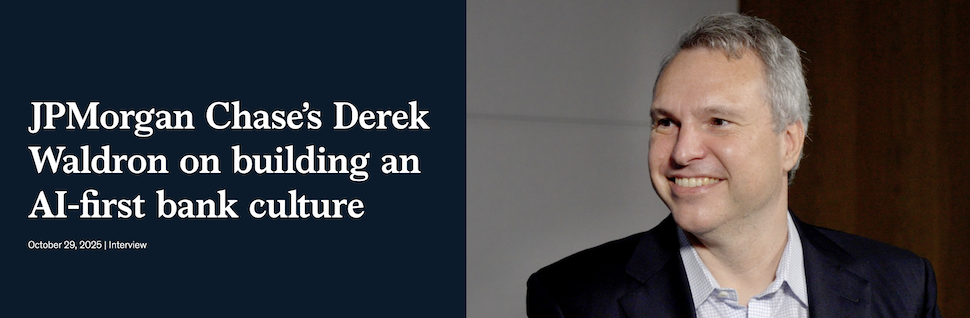
- Nearly 250,000 employees have been granted access, with almost 50% using AI daily to read contracts, analyze credit, prepare data, and assist in sales.
- The rollout began in 2024 as a voluntary adoption, spreading due to an internal “FOMO” effect; it was not mandatory, but “went viral” like a cultural revolution.
- The LLM Suite evolved from a chatbot into a comprehensive AI ecosystem, connecting corporate data, internal applications, and analytical tools – aiming for an “AI-connected enterprise.”
- JPMorgan applies a two-pillar strategy: (1) reinventing core value journeys such as credit, fraud, and marketing; (2) empowering employees with self-service tools for innovation.
- Financial efficiency increased by 30–40% annually thanks to AI, with ROI tracked at the initiative level.
- McKinsey estimates the banking industry could save $700 billion, but the advantage mainly belongs to pioneering banks.
- The “AI Made Easy” training program attracted tens of thousands of employees; new job roles like prompt engineer and context engineer emerged.
- Major risks: data security, shadow IT, deepfakes, and trust in agentic AI systems during long-term autonomous operation.
- JPMorgan sees AI as a tool for democratizing innovation, where “everyone will become an AI manager” in the future.
📌 JPMorgan Chase is leading the AI-first wave in finance, with $18 billion invested and nearly 125,000 daily AI users. The LLM Suite is transforming the work culture, resulting in a 30–40% annual productivity increase. However, major challenges include security, AI ethics, and the ability to control increasingly powerful autonomous agentic systems.


